
 Primary care
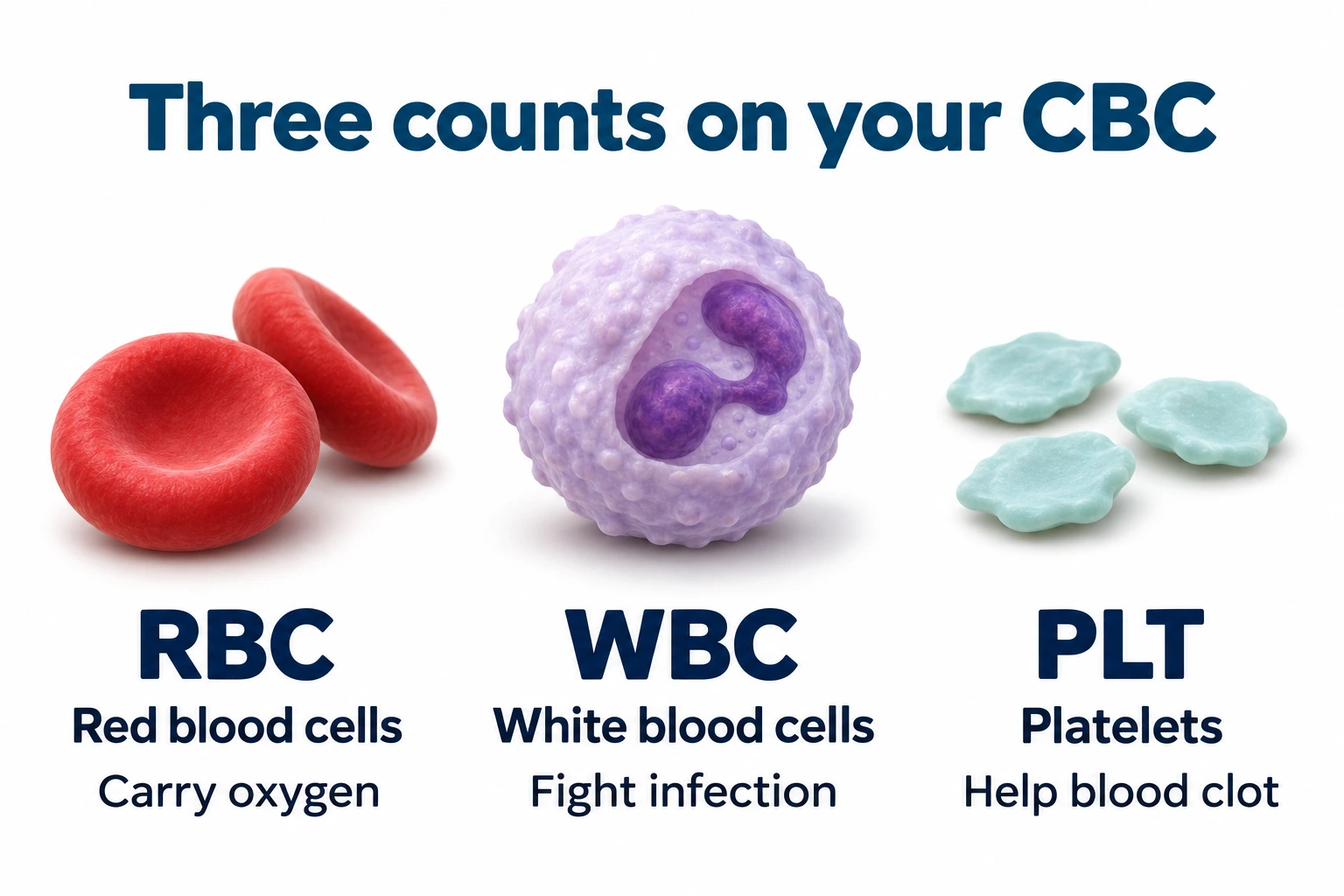
What does a CBC test show? A complete blood count gives you three starting points on a crowded report. Look for your red blood cell count, white blood cell count and platelet count. The other rows describe those cells in more detail.
What tests are in a CBC blood test?
Along with the three counts, the red cell section shows how much hemoglobin your blood contains, how much space the cells take up and how they vary in size. These measurements describe different features of the same cells.
What is hematocrit on a blood test?
RBC counts the cells in a sample of blood. Hemoglobin, often shown as Hgb, measures the concentration of the protein that carries oxygen in your blood. Hematocrit, or Hct, tells you what share of your blood volume consists of red cells. A hematocrit shown as a percentage refers to that share.
What is MCV in blood work?
MCV tells you the average size of a red blood cell. Two samples can have the same average even if one has a wider mix of cell sizes.
What is RDW on a CBC?
RDW tells you how much the red cells vary in size. Read it alongside MCV when your clinician asks about the size of your red cells.
What is MCHC on a blood test?
MCHC describes how concentrated hemoglobin is inside the red cells. It helps your clinician interpret other results such as a low hemoglobin level.
Where to find white cells and platelets
WBC is the total white blood cell count. These cells help defend the body. A CBC with a differential also breaks white cells into groups such as neutrophils and lymphocytes.
PLT counts platelets, the small cell fragments that help stop bleeding. A platelet count tells you how many circulate in your blood. Your clinician can order a different test if the question concerns how well they work.
When two neutrophil rows seem to disagree
If the portal flags your neutrophil percentage but the absolute count is in range, copy both rows with their units. A percentage tells you the share of all white cells. An absolute count tells you how many neutrophils are in a volume of blood. A change in another cell group can shift the percentage. Ask which row matters for the reason you had the test.
What a flag on the report tells you
Read across the row from your result to the unit and the reference range. An H or L means your number sits above or below the interval that lab uses. The letter alone cannot tell you the cause or how much the finding matters for you.
If you have an older CBC, keep the date and lab name with each report. Different labs can use different methods, units or ranges. Ask which changes over time matter in light of why you had the test.
Common questions about a CBC report
What does a CBC with differential mean?
When comparing a CBC vs. CBC with differential, look for a breakdown of the white cells. A basic CBC gives the total. The differential adds the individual types, so you can see the neutrophil count if the lab reports it.
Is MCH the same as MCHC?
MCH refers to the average amount of hemoglobin per red cell. MCHC describes how concentrated that hemoglobin is within the cells.
Does a high white count tell me which infection I have?
A high count has several possible explanations. Your clinician uses the rest of the report, your symptoms and other findings to decide what to check.
Can a result in range explain how I feel?
A result within the reference range can coexist with symptoms. Describe what you feel and when it started, even if the portal shows no flags.
Which number should I ask about first?
Start with the reason for the order. If the clinician wanted to check for anemia, ask how the hemoglobin and red cell measurements fit together.
Share the full report with the clinician who ordered it. Ask which finding needs attention and what you should do next.
Sources and further reading
- MedlinePlus on the complete blood count (opens in a new tab)
- MedlinePlus on red cell indices (opens in a new tab)
- MedlinePlus on laboratory reference ranges (opens in a new tab)
- MedlinePlus on platelet tests (opens in a new tab)
- MedlinePlus on the blood differential (opens in a new tab)
- MedlinePlus on changes in white cell percentages (opens in a new tab)