

 Women's health
The specific difference:
- Pelvic exam: The doctor uses their hands and eyes to check the shape, size and condition of the pelvic organs.
- Pap test, also called a Pap smear: The doctor takes a scraping of cells from the cervix and sends it to a laboratory to rule out cancer.

What a pelvic exam includes
The doctor may examine the skin of the external genitals, use a speculum to look at the vagina and cervix, and feel the uterus and nearby structures with a gloved hand while gently pressing on the lower abdomen. The steps needed depend on the reason for your visit.
An exam may be recommended because of pain, unusual discharge, unexpected bleeding or another symptom. It may also be needed for a procedure, such as inserting an intrauterine device. The exam itself often takes only a few minutes, but the conversation and tests take additional time.
An exam can help identify tenderness or visible changes, but it does not rule out every gynecologic condition. Some questions require laboratory tests, imaging or further evaluation.
What a Pap test shows
For a Pap test, the doctor uses a small brush or a similar instrument to collect cells from the cervix, the lower part of the uterus. The laboratory checks them for abnormalities. This test is also called cervical cytology.
Its purpose is to detect changes before cervical cancer develops, although cancer cells are sometimes found in the sample as well. An abnormal result does not automatically mean cancer. It means the result needs to be interpreted and further evaluation carried out when indicated.
A Pap test is not a general health check of all the reproductive organs. In particular, it is not used to screen for ovarian cancer. If you develop persistent bloating, pelvic discomfort or unusual bleeding, tell your doctor, even if your last Pap test was normal.
How HPV testing differs
An HPV test detects types of human papillomavirus associated with a high risk of cervical cancer. A Pap test looks for abnormal cervical cells. Depending on the screening program, the doctor may order an HPV test alone, a Pap test alone or both together.
| Examination | Main purpose | What to ask |
|---|---|---|
| Pelvic exam | Assess symptoms and examine the pelvic organs | Which parts of the exam are needed and why |
| Pap test | Find abnormal cervical cells | Whether a sample will be taken and how the result will be shared |
| HPV test | Detect HPV associated with a high risk of cervical cancer as part of cervical screening | Which test and collection method are appropriate |
| Pelvic ultrasound | Obtain images of the pelvic organs | Whether an ultrasound is needed to answer a separate question the doctor has |
A positive HPV result does not establish when the infection began or who passed it on. It also does not mean that the person has cancer. The next steps depend on the test result and the previous screening history.
A newer option you can ask about
Collecting your own sample for HPV testing
Some patients who meet the eligibility criteria can now collect their own vaginal sample for an approved HPV screening test. This may help people who find a speculum exam difficult to tolerate complete their screening. This collection method differs from a Pap test, which requires cells from the cervix.
If discomfort or a difficult past experience is keeping you from screening, ask which options are appropriate. Do not assume that an ordinary home swab or an unapproved kit provides the same information.
How often cervical screening is needed
Ages and intervals for cervical screening
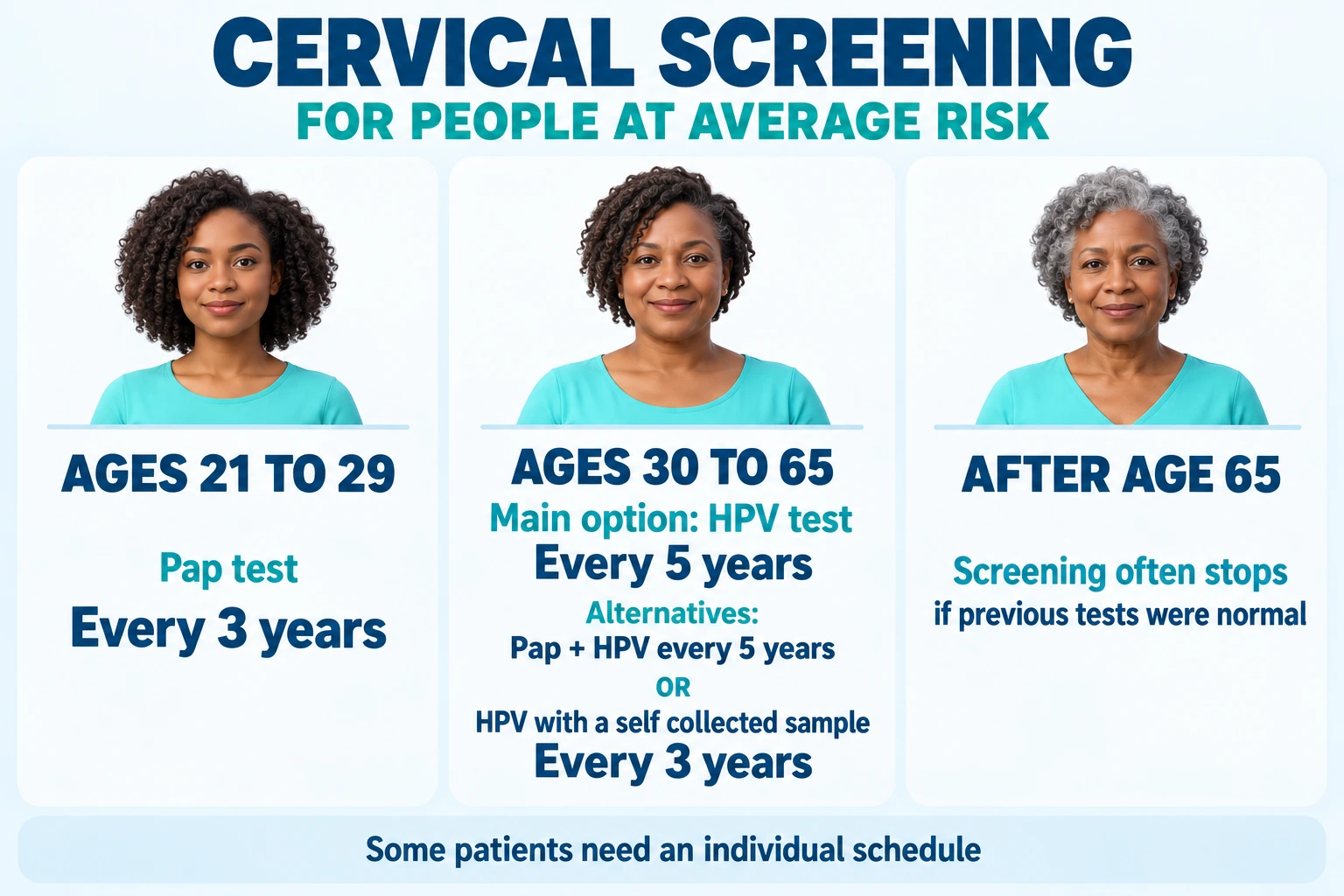
1. Age intervals for people at average risk:
- Ages 21 to 29: A Pap test once every 3 years.
- Ages 30 to 65: The main option is an HPV test once every 5 years. Alternatives are a Pap test plus an HPV test once every 5 years OR HPV testing with a sample you collect yourself once every 3 years.
- After age 65: Screening is often stopped if previous tests were normal.
2. When these rules do NOT apply and an individual schedule is needed:
- Previous test results were abnormal.
- There are immune system problems or other factors that increase risk.
- The uterus has been surgically removed. This depends on whether the cervix was removed and why the operation was performed.
A preventive visit may include neither examination
At a preventive visit, you can discuss your menstrual cycle, contraception, sexual health, symptoms and screening needs. An exam or Pap test may be included when indicated, but the visit involves more than these procedures.
For an adult without symptoms, the need for a routine pelvic exam is discussed in light of medical history and preferences. ACOG does not recommend treating an annual exam as automatically required for every patient without symptoms. Some tests for sexually transmitted infections can also be done without such an exam, using an appropriate urine or swab sample.
How to prepare without unnecessary complications
Ask for instructions specific to the examination you are having. Before a Pap test, you are often advised to avoid vaginal intercourse, douching and vaginal products for two days. If you use a prescribed vaginal medicine, ask whether it can be interrupted.
If your period starts, call the clinic rather than automatically canceling the appointment. Light bleeding may not interfere with the test, while heavier bleeding can affect the sample. A visit for unusual bleeding should not be postponed just because the bleeding is still continuing.
Tell the doctor if exams cause pain or anxiety. You can ask for each step to be explained, request a pause, change position when possible or discuss the size of the speculum. You can ask for the exam to stop.
Sources
- American College of Obstetricians and Gynecologists: Pelvic Exams (opens in a new tab)
- National Cancer Institute: Cervical Cancer Screening (opens in a new tab)
- Cleveland Clinic: Pap Smear (opens in a new tab)
- National Cancer Institute: Self Collection for HPV Testing and the 2025 Guidelines (opens in a new tab)
- HRSA: Updated Cervical Cancer Screening Guidelines 2026 (opens in a new tab)
- CDC: Screening for Ovarian Cancer (opens in a new tab)
- ACOG: Screening for Cervical Cancer 2026 (opens in a new tab)
- CDC: HPV Infection and Counseling About Positive Results (opens in a new tab)