
 Ultrasound
A full or empty bladder?
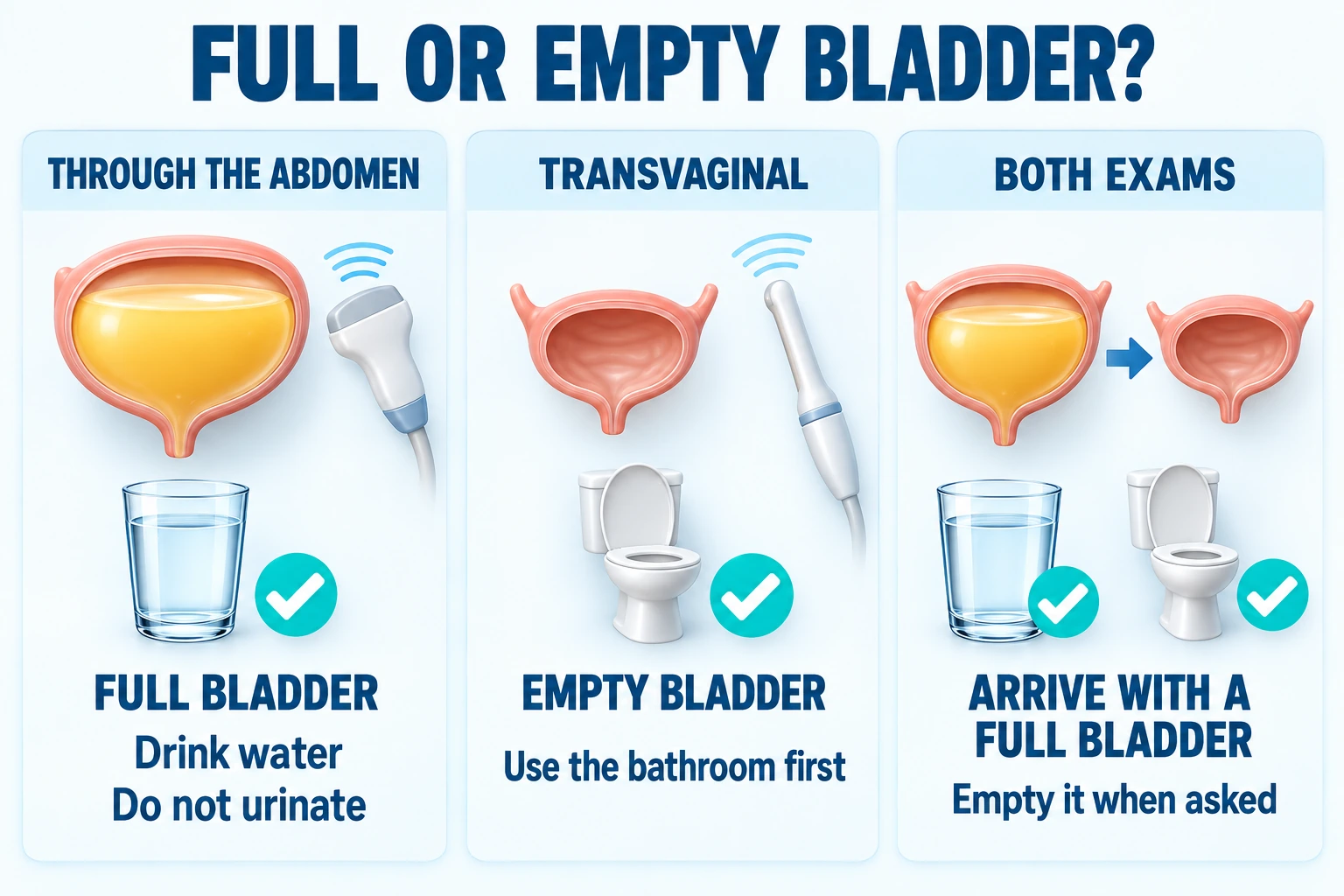
- Having an ultrasound through your abdomen? Arrive with a full bladder. Drink water beforehand and do not use the bathroom.
- Having an internal, transvaginal ultrasound? The opposite applies. Before the procedure, you must use the bathroom and empty your bladder completely.
- Scheduled for both? Arrive with a full bladder first. During the exam, the doctor will ask you to use the bathroom.
How much water should I drink?
- How much to drink: The standard amount is 1 liter, or 32 ounces, of plain water 1 hour before the ultrasound, without using the bathroom.
- Exceptions:
- Heart or kidney failure, when doctors have told you to limit how much you drink.
- Difficulty holding urine.
- The main requirement: Always drink exactly the amount listed in your instructions. Your doctor will tell you the specific amount of water. If you have forgotten, call our clinic.

Why fill the bladder?
A full bladder can help ultrasound waves pass through and move the bowel away from the structures being examined.
What to do if your bladder is painfully full
The idea that “the fuller, the better” is a mistake. An overstretched bladder distorts the internal organs and reduces image quality.
What to do if it hurts: Tell the doctor or nurse immediately before the ultrasound.
The solution: You will be allowed to use the bathroom a little, partially emptying your bladder, to relieve the pain and obtain a clear image.
Can I have an ultrasound during my period?
Yes! You can have an ultrasound during your period.
You can have the exam: Menstruation is not a reason to cancel an ultrasound.
What to tell the doctor: The first day of your last period, whether your cycle is regular and whether pregnancy is possible.
Hygiene before an internal, transvaginal ultrasound: You must remove your tampon or menstrual cup.
When to cancel the procedure and contact a doctor: If the bleeding is very heavy or you develop a sharp pain.
What each type of exam shows
A pelvic ultrasound creates images using sound waves. It allows the uterus, its lining, the ovaries and nearby structures to be assessed. The exam can help investigate pelvic pain, unusual bleeding or a change that needs a closer look.
What happens during a pelvic ultrasound?
During a transabdominal exam, the specialist applies gel and moves the probe over your lower abdomen. Images are obtained through the abdominal wall. For a transvaginal ultrasound, a narrow probe with a protective cover and lubricant is inserted into the vagina. Being close to the pelvic organs allows some structures to be seen in greater detail.
These methods can complement each other. A request for an internal exam does not automatically mean that something serious was found during the external scan. Additional images may be a routine part of the examination needed to answer the doctor’s question.
A pelvic ultrasound also differs from a pelvic exam and a Pap test. It creates images but does not involve collecting cervical cells for screening.
Food and medicines before your appointment
Before a routine pelvic ultrasound, you can often eat as usual. The exam itself generally does not require fasting. However, a combined abdominal and pelvic ultrasound, sedation or another procedure on the same day may change the instructions.
The question “Can I eat before a pelvic ultrasound?” should therefore be followed by another: “Will anything else be done at the same appointment?” Check this before assuming that being allowed to drink water also means you can have breakfast.
How long the exam takes and the results
For many pelvic ultrasounds, the scan itself takes about 30 minutes.
Sources
- Johns Hopkins Medicine: Pelvic Ultrasound (opens in a new tab)
- RadiologyInfo from the ACR and RSNA: Pelvis Ultrasound (opens in a new tab)
- AIUM: Practice Parameter for Ultrasound of the Female Pelvis 2024 Revision (opens in a new tab)
- Cambridge University Hospitals: Ultrasound Scan of the Pelvis (opens in a new tab)
- Virginia Beach OBGYN: Instructions for Non Pregnant Patients (opens in a new tab)
- MedlinePlus: Pelvic Ultrasound Through the Abdomen (opens in a new tab)