
 Primary care
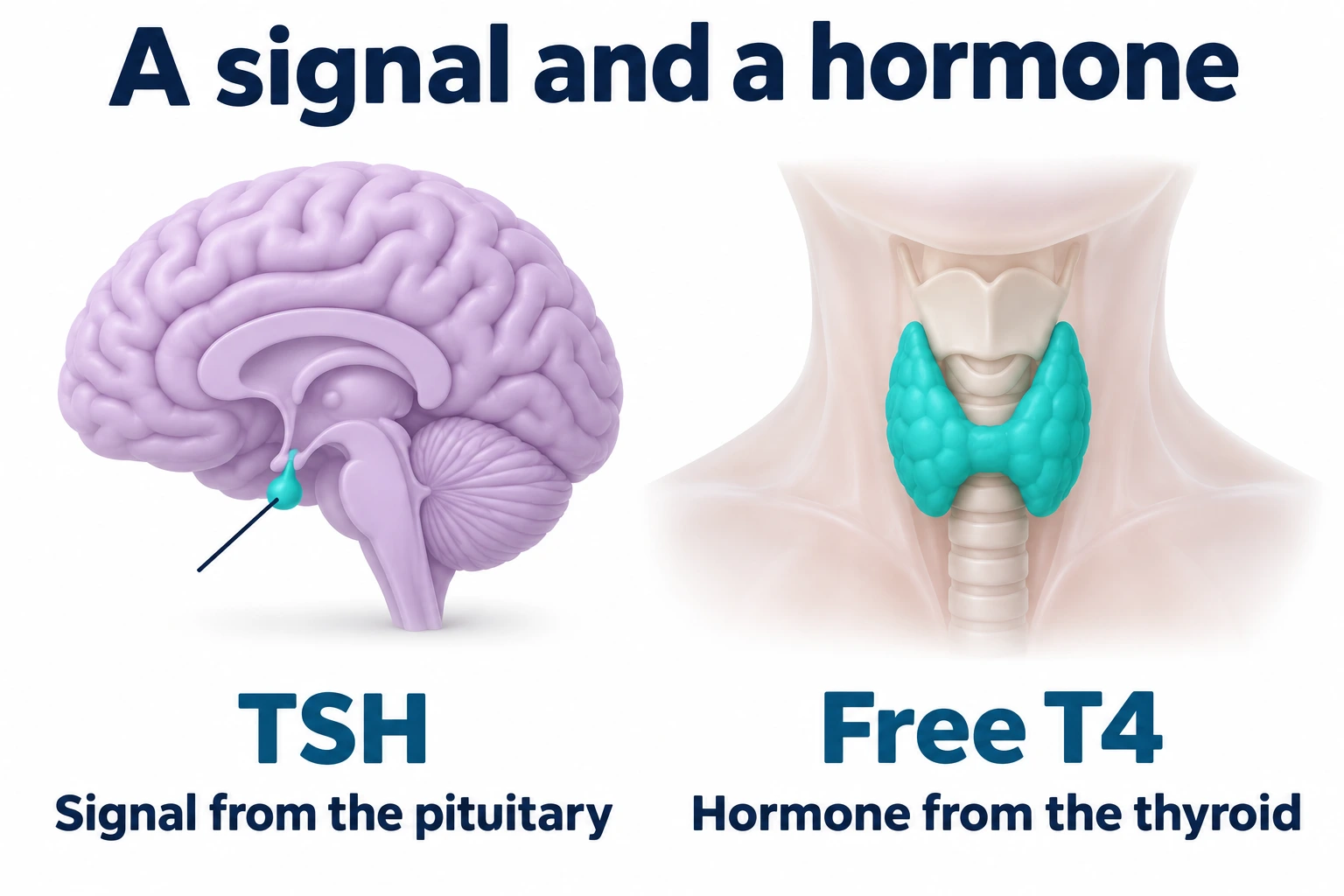
Your TSH blood test measures a signal from the pituitary, a small gland at the base of your brain. Free T4 measures a hormone from the thyroid in your neck. If you have both results, reading them together can help explain how the glands respond to each other.
What does TSH measure?
Your pituitary gland makes thyroid stimulating hormone, or TSH. This signal tells the thyroid to produce hormone. When the pituitary senses too little thyroid hormone, it tends to release more TSH. When it senses more, it tends to release less.
What is free T4?
T4 is one of the hormones your thyroid makes. Much of the T4 in your blood travels attached to proteins. Free T4, sometimes listed as FT4, measures the portion that circulates without those proteins. Total T4 includes both portions. Check the label before you compare two reports.
How to read thyroid function test results together
High TSH with normal or low free T4
A high TSH with low free T4 fits a pattern in which the thyroid makes too little hormone despite a stronger signal from the pituitary. If free T4 remains within range, the signal can already show a change. Clinicians may use the term subclinical hypothyroidism when that pattern persists in the appropriate setting.
Low TSH with normal, high or low free T4
Low TSH with high free T4 can suggest too much thyroid hormone. A low TSH with free T4 in range has several possible explanations. Another thyroid hormone called T3 can help distinguish them. Low TSH together with low free T4 has a different meaning and can prompt a closer look at the pituitary.
Why your order might say TSH with reflex to free T4
A reflex order gives the lab a rule for running the next test. The lab checks TSH first. If it meets the conditions for that order, the lab also measures free T4. An order can therefore mention free T4 while your results page lists TSH alone.
If you see one number under an order that names two tests, open the result details. Write down the number next to TSH. Look for a separate line labeled free T4 or FT4 with its own value and units. Leave that space blank if you cannot find a result. Ask the office whether the lab ran the second test before comparing it with free T4 from an earlier visit.
What can change the interpretation
Pregnancy can change the reference ranges clinicians use for thyroid tests. Some medicines and supplements also affect the results. Biotin, an ingredient in some hair and nail products, can interfere with certain laboratory methods.
When you discuss an unexpected value, have the names of any medicines or supplements at hand. Include earlier results and tell the clinician about symptoms or pregnancy. Ask what the pair of values means in your circumstances.
Common questions about thyroid test results
Do TSH and free T4 have to match?
They measure different substances and use different units. Compare each value with its own range. Then look at the pattern together.
Is a normal free T4 enough to explain a low TSH?
It gives part of the picture. Your clinician may review T3, your history or a repeat result before interpreting the low TSH.
Does subclinical mean I cannot have symptoms?
The word describes a laboratory pattern. Tell your clinician what you feel, whether or not that term appears in your notes.
Does a TSH test tell me why my thyroid changed?
It can indicate a change in thyroid function. Identifying the cause may require more details about your health or another test.
What if my report says thyroxine?
Thyroxine is another name for T4. Look for free or total beside it so you know which measurement the lab reported.
Ask the clinician who ordered the tests whether both results fit the reason for testing and whether another measurement would answer the question.
Sources and further reading
- American Thyroid Association on thyroid function tests (opens in a new tab)
- MedlinePlus on TSH testing (opens in a new tab)
- American Thyroid Association on hyperthyroidism (opens in a new tab)
- ARUP Laboratories on TSH with reflex to free thyroxine (opens in a new tab)
- ARUP Consult on laboratory evaluation of hypothyroidism (opens in a new tab)
- UW Medicine on the components of a reflex thyroid order (opens in a new tab)