
 Primary care
Once you leave with a Holter monitor, the recording follows you through work, meals and sleep. The sensors on your chest pick up signals your team can match with your notes. That makes a short entry about a flutter on the stairs more useful than simply writing that you felt unwell.
What does a Holter monitor record?
A Holter monitor records your heart’s electrical activity as you go about your day. Check when your recording starts, when it ends and how to return the equipment and diary.
If your device has wires, have the team show you how to carry the recorder and where each sensor sits. If you wear a patch, ask how to recognize a loose edge or a problem with the recording. Save the support number so you can reach it while you are out.
How long do you wear a Holter monitor?
Many Holter recordings last a day or two. Some orders call for longer. Use the stop time your monitoring team gave you.
What to check before you shower, exercise or sleep
Can you shower with a Holter monitor?
Water can damage a conventional recorder. Keep it dry unless your team gives you specific instructions for your model. Some systems have a procedure for showering. Ask whether that procedure applies to yours before you disconnect anything or step into water.
Can you exercise with a Holter monitor?
Keep to the activities your clinician has cleared. The recording can capture a trip up the stairs or a walk to the bus in the context of an ordinary day. If your job involves strong magnets or your workout involves swimming, ask about that activity in advance.
How to sleep with a Holter monitor
Keep recording during sleep as instructed. If you have leads, ask how to position the pouch so turning over will not pull on the wires. Keep the diary close enough to reach if a symptom wakes you.
What to put in your Holter monitor diary
Write the time, the activity and what you felt. For example, an entry could read, “At ten past two I was walking up the stairs and felt a flutter.” If you remember the duration, add it. A time and a few plain words give the reader more to work with than a guess about the rhythm.
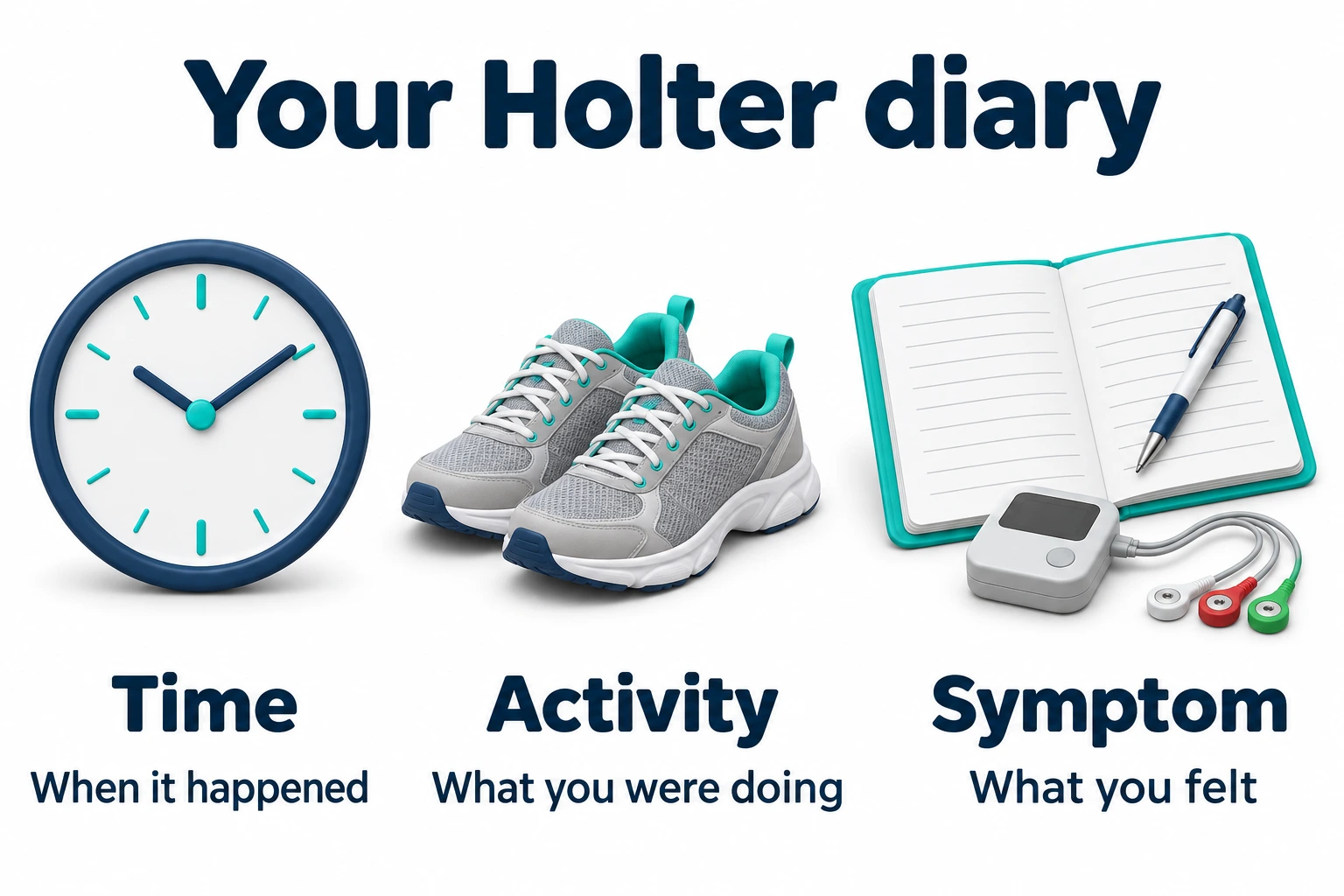
Use the diary format you received. At the end of the recording period, return it as directed, even if you had none of your usual symptoms.
What if I miss the symptom button?
If you forget to mark a symptom on a continuously recording Holter, write down the date, approximate time and what you felt as soon as you remember. Label it as an estimate. The button on a continuous monitor marks a moment in a recording already in progress. If you are unsure what your device records without a button press, check its instructions or call the monitoring team.
What to do and what not to do while wearing a Holter monitor
What if an electrode falls off?
Follow the replacement instructions for that device. Contact the monitoring team if you cannot reattach it or the recorder turns off. Make a note of the time.
What if the adhesive bothers my skin?
Tell the team if you have a known tape allergy. If skin irritation develops while you wear the device, ask how to manage it without interrupting the recording.
Can I take it off once I have felt my usual symptom?
Keep wearing it for the time you were given unless the monitoring team tells you to stop. Symptoms and changes in rhythm do not always occur together.
Should I write down rest as well as activity?
Yes, if you notice a symptom at rest, say so. “Sitting at my desk” helps the reviewer connect the time in your diary with the recording.
How does a Holter monitor work with my diary?
Your care team arranges analysis of the electrical tracing and compares it with your notes. Ask the clinician who ordered the test how you will discuss the result.
Before your first night with the monitor, check the water rule, the stop time and whom to contact if the device comes loose.
Sources and further reading
- American Heart Association on Holter monitoring (opens in a new tab)
- Mayo Clinic on wearing a Holter monitor (opens in a new tab)
- MedlinePlus on ambulatory electrocardiography (opens in a new tab)
- Veterans Affairs on caring for a wearable monitor (opens in a new tab)
- iRhythm patient instructions on a missed symptom marker during continuous recording (opens in a new tab)